
Although Cashless ATMs has been the preferred method of payment for many years, the ease of use of credit and debit cards is rapidly overtaking it. If at all possible, most individuals would rather pay with a card than cash; in fact, if cash is required, some customers might not even bother to purchase there.However, what about companies who typically accept cash payments? That’s where Cashless ATMs, often considered the best payment gateway, are useful. This post will define Cashless ATMs, describe how they operate, and discuss their advantages, disadvantages, and application procedure. Let’s get going.
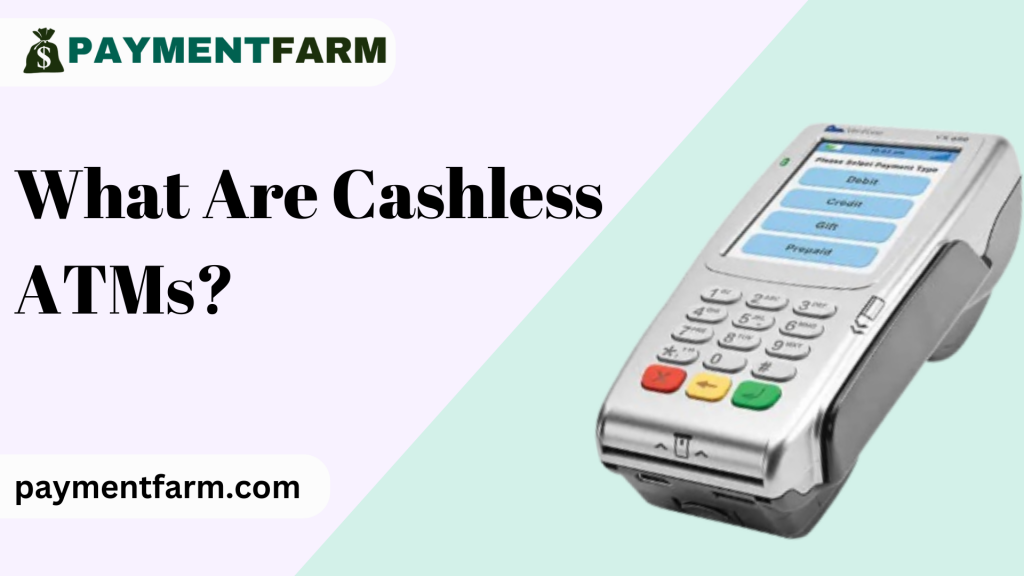
What are Cashless ATMs?
Cashless ATMs are payment terminals that let users use a debit card to make purchases much like they would if they were taking out cash from an ATM. Other names for these terminals are point-of-banking technology or solution.The distinction is that the money is transferred straight into the merchant’s account rather than to you.This system was created to give companies who were deemed to be high-risk, such authorized medicinal marijuana dispensaries, an alternate method of payment. It was also applied to companies that were regarded as being on the “blacklist” and usually took cash as the primary payment process method. Nonetheless, a variety of establishments, including as amusement parks, restaurants, bowling alleys, nightclubs, farmer’s markets, and pawn shops, have adopted this payment option in recent years.
How do Cashless ATMs Work?
The term “cashless ATM” often causes confusion because of its association with traditional ATMs. In reality, cashless ATMs function more like standard point-of-sale (POS) systems used by businesses to process debit card payments. Customers swipe their card and enter a PIN using a small card reader, similar to a POS terminal. Where a cashless ATM differs from a traditional bank ATM is in how the transaction is completed.
After selecting an amount to “withdraw”—typically in preset increments such as $10 or $20—the machine prints a voucher confirming the transaction. No physical cash is dispensed. Instead, the selected amount is deposited directly into the merchant’s account. The customer then presents the voucher to the merchant and receives the purchased goods or services. As with a standard ATM, transactions must be made in predetermined increments. If the purchase total is less than the selected amount, the merchant provides change. For example, if a customer withdraws $50.00 to pay for a $45.50 purchase, the merchant returns $4.50 in change. The two primary differences between a cashless ATM and a traditional POS system are that cashless ATMs require PIN entry for every transaction and allow payments only in preset amounts. From the customer’s perspective, however, the experience is very similar.
How to use Cashless ATMs?
You can take the following actions to use a Cashless ATM:
- Open the digital wallet or bank app on your phone and log in.
- Decide which account you wish to use.
- Scan the QR code or tap the contactless icon at the ATM.
- Put in your PIN.
- Enter the card’s PIN linked to the account you are now using.
- Finish the transaction.
To confirm your identity, several banks provide fingerprint or face recognition.Although cardless ATMs can save time and minimize interaction, they might not be widely available and could pose security threats.
Cashless ATMs companies
- Cardtronics
- NCR Atleos
What Advantages Do Without Cash ATMs Offer?
Both customers and merchants can gain greatly from using cashless ATM. A list of them is as follows:
- Payment security is increased and the likelihood of Payments Fraud, theft, or chargebacks is decreased by using a PIN.
- It is simple to set up, requires little room, and does not require a conventional ATM.
- Cashless ATMs significantly simplify the purchasing procedure for customers in locations where cash is typically utilized.
- Much less expensive up front than a standard ATM
- Great for companies who typically have trouble obtaining a regular merchant account.
- has less criteria than a typical merchant account for merchants.
- lessens the quantity of money that buyers and retailers must manage.
- gives the merchant access to real-time reporting.
- permits PIN-based debit cards to be accepted by the merchant.
- Within 48–72 hours, money is transferred to the merchant’s account.
- Although it can damage their connection, a merchant may decide to impose a convenience fee to the client.
- From minor sums like $5 to $10 to higher increments like $100 or even $1000, they can be programmed with varying increment amounts.
Cashless ATM drawbacks
There are drawbacks to cashless ATM for both consumers and businesses. Among them are:
- For the usage of the cashless ATM, certain suppliers may charge merchants a monthly fee.
- Change must be easily accessible, and transactions can only be completed in predetermined increments.
- Customers will probably be assessed a cash advance or out-of-network fee because the cashless ATM is an out-of-network bank ATM.
- Businesses have the option to charge customers a convenience fee for using the ATM.
- The fees may not be worth the expense, depending on how much a vendor charges for the machine’s use.
- Even though they are far more secure, fake receipts are still possible.
What Are the Requirements and Application Process for without cash ATM Setup?

Although creating a non-cash ATM is easier than creating a regular merchant account, there are still certain prerequisites and procedures to adhere to.Both an ACH authorization form and an application form must be filled out and signed. Either your account provider or a voided check will need to confirm the facts of your bank account. Lastly, you must demonstrate your understanding of the principles listed in the application form by presenting a signed W-9.The seller will check your application when you submit it, and if it is approved, they will send you the no-cash ATM. All you need to do is plug it in and connect it to the internet.The application procedure often takes 24 to 72 business hours in total.
To sum up
For businesses who are unable to obtain a standard merchant account for the purpose of accepting debit and credit card payments, a Cashless ATMs serves as a payment option. From a customer perspective, they function similarly to a point-of-sale (POS) or ATM.You probably won’t utilize a cashless ATM much if your company currently accepts credit and debit card payments using a regular POS merchant account system. However, for companies who usually accept cash payments, they might still be a compelling substitute for a regular ATM on the property.
FAQs
How can I take money out of a cashless ATM?
Launch the Google Pay app on your smartphone, then scan the QR code displayed on the ATM screen. Payee information and the amount are pre-filled. All of the bank accounts that are eligible for cash withdrawals are listed on the payflow screen.
What is the no-cash ATM rule?
If you cash out more than ten hours in a month, each ATM will be subject to a fixed penalty of ₹10,000. The penalty will be borne by the bank that meets the cash requirement of that particular White Label ATM (WLA).
A cashless machine what is it?
Customers perceive cashless ATMs as being similar to credit card machines because they can swipe their cards or enter them into a chip reader. However, as with an ATM machine fee, the customer is responsible for paying the transaction fee. This indicates that there are no expenses for the merchant related to the transaction.